


What Is an iGaming API? How Unified Technology Accelerates Operator Integration in Mexico
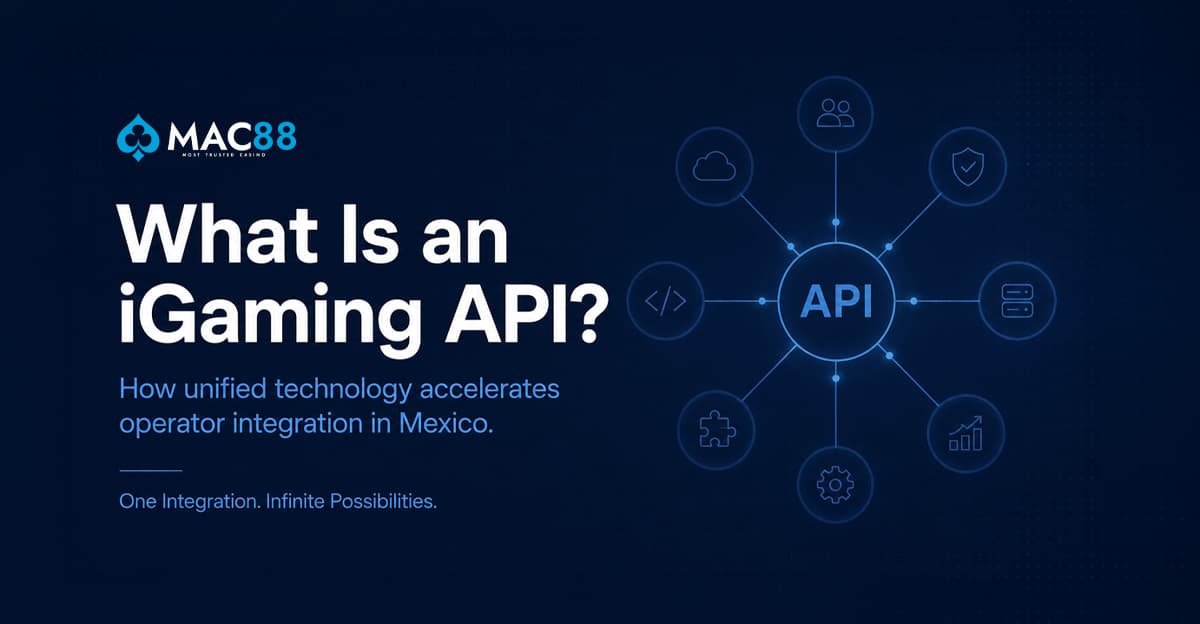
As Mexico’s regulated online gaming market continues to mature, operators face increasing
pressure to launch quickly while offering competitive content portfolios from day one. However,
integrating dozens of game providers individually can significantly extend time-to-market,
creating unnecessary technical complexity and operational costs.
Application Programming Interfaces (APIs) have become the foundation of modern iGaming
infrastructure, enabling gaming platforms, payment systems, digital wallets, player management
solutions, content providers, and other essential services to communicate through standardized
connections. Rather than building separate integrations for every supplier, operators can rely on
a unified API that consolidates multiple services into a single technical framework.
This approach has become particularly relevant for operators entering or expanding within
Mexico, where speed, scalability, security, and operational efficiency are increasingly important
competitive advantages.
Simplifying a Complex Technical Process
At its core, an API acts as a bridge between different software systems, allowing them to
exchange information securely and automatically. In the iGaming sector, APIs facilitate
everything from launching casino games and sports betting products to connecting payment
gateways, digital wallets, player accounts, bonus engines, reporting tools, responsible gaming
systems, and third-party services.
Traditional integration models often require operators to connect individually with every game
supplier, each using different technical specifications, certification processes, and maintenance
requirements. As gaming portfolios continue to grow, this fragmented approach can delay
launches, increase development workloads, and make long-term maintenance more complex.
Unified aggregation technology addresses this challenge by centralizing these connections.
Instead of managing dozens of independent integrations, operators connect once and gain
access to a broad ecosystem of certified content and integrated services through a standardized
interface.
Security as a Core Component
Beyond simplifying connectivity, security is one of the most critical functions of an API. Modern
iGaming platforms process large volumes of sensitive information, including player data,
financial transactions, and account activity, making secure communication between systems
essential.
For this reason, API architectures are built around secure authentication methods, encrypted
data transmission, and strict access controls that help protect information exchanged between
operators and service providers.
At MAC88, security is considered a fundamental element of its technology. The company’s
unified API is designed to support secure data exchange while maintaining the reliability and
stability operators require to manage daily operations confidently.
Accelerating Market Entry
For new operators, reducing technical barriers can have a direct impact on business
performance. Faster integrations translate into shorter deployment cycles, quicker content
activation, and more efficient platform management.

MAC88’s unified API has been designed around this principle. Through a single point of
connection, operators gain access to more than 60 premium gaming providers without the need
to complete individual technical integrations for each one.
Compared with traditional multi-provider integration models, this unified approach can reduce
implementation time by approximately 30%, allowing operators to focus resources on customer
acquisition, localization, and business growth rather than repetitive development work.
A practical example illustrates the difference. Under a traditional integration model, an operator
wishing to launch with 20 different game providers would typically need to establish and
maintain 20 separate technical connections, each with its own documentation, testing process,
and ongoing updates. With MAC88, the operator completes a single integration with the unified
API and immediately gains access to the entire ecosystem of integrated providers, significantly
reducing both implementation effort and future maintenance.
Beyond reducing implementation time, centralized integration also simplifies future platform
expansion. As new providers become available within the ecosystem, operators can activate
additional content with minimal technical effort, supporting long-term scalability.
Building for Operational Efficiency
Modern aggregation platforms do more than consolidate content. They also streamline ongoing
operations by providing standardized documentation, consistent technical support, and
centralized maintenance.
For operators, this means fewer compatibility issues, simplified updates, and reduced
engineering overhead throughout the platform lifecycle.
As competition intensifies across Latin America’s online gaming industry, technological
efficiency is becoming just as important as the quality of the games themselves. Businesses
that can launch faster while maintaining operational flexibility are better positioned to respond to
market opportunities and evolving player preferences.
Supporting Growth in Mexico
Mexico remains one of Latin America’s most established online gaming markets, attracting both
domestic operators and international brands seeking regional expansion. As competition
continues to increase, infrastructure decisions made during platform deployment can influence
long-term operational performance.
By simplifying technical integration through a single API and consolidating access to an
extensive network of premium content providers, MAC88 enables operators to reduce
implementation complexity while accelerating their path to market.
For businesses preparing to enter Mexico or expand existing operations, unified integration
represents a practical technology strategy that balances speed, security, scalability, and
operational efficiency in an increasingly competitive landscape.